Health, Disability Gender Rights Icons: A Practical Evaluation for Inclusive Design
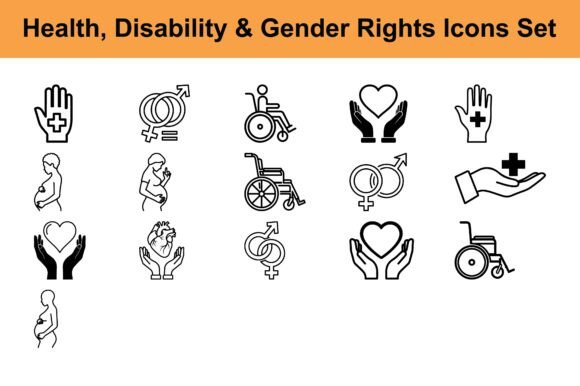
Visual communication plays a critical role in how messages about health, accessibility, and human rights are received. The Health, Disability Gender Rights Icons set is a curated collection of vector graphics designed to represent concepts such as medical assistance, wheelchair accessibility, pregnancy, gender identity, and support services. Presented on a clean white background in a modern vector style, this set aims to provide clarity and versatility for projects that prioritize inclusivity, equality, and well-being.
This article offers a balanced evaluation of the Health, Disability Gender Rights Icons set. It explores what this collection offers, examines reasons someone might consider using it, discusses benefits and tradeoffs, identifies suitable use cases, and considers alternatives. The goal is to help you decide whether this icon set aligns with your project goals, audience needs, and design requirements.
What Is the Health, Disability Gender Rights Icons Set?
The Health, Disability Gender Rights Icons collection is a set of symbols that visually communicate key themes in healthcare, disability support, and gender rights. Included symbols typically cover medical assistance, support services, a pregnant woman, wheelchair accessibility, and gender symbols. The icons are delivered in AI (fully editable vector source), EPS (scalable vector format), and JPG (high-resolution) file formats, making them adaptable for digital and print applications.
This set is designed for use in healthcare projects, educational materials, nonprofit campaigns, advocacy and awareness initiatives, social media graphics, infographics, and community-focused designs. The underlying intention is to promote inclusivity, equality, and respect for human rights through clear visual representation.
Why Might You Be Interested in This Icon Set?
Several practical motivations may lead someone to evaluate the Health, Disability Gender Rights Icons set:
- Need for clear and respectful representation: If your project requires symbols that accurately and sensitively represent health conditions, disabilities, or gender identities, this set offers pre-designed options that aim to avoid stereotypes.
- Time and resource efficiency: Creating custom icons from scratch requires design skills, time, and software. A ready-made set reduces production time and cost.
- Consistency in visual language: Using a unified icon set ensures that all symbols share a consistent style, stroke weight, and visual tone, which improves the professional appearance of your materials.
- Compliance or advocacy requirements: Organizations working in healthcare, social services, or human rights often need visual assets that support accessibility and inclusive messaging.
- Versatility across formats: The inclusion of AI, EPS, and JPG files means the icons can be used in vector editing software, presentation tools, web design, and print layouts.
Clarity and Simplicity
The clean white background and modern vector style help ensure that each icon remains legible at various sizes. This is particularly important for accessibility-focused designs, where symbols must be quickly understood by diverse audiences, including people with cognitive or visual impairments.
Meaningful Symbol Selection
The set includes symbols that address specific, often underrepresented topics such as pregnancy, gender rights, and disability support. This thoughtful selection can help your designs communicate nuanced messages about equality and well-being without relying on generic or ambiguous imagery.
Editable and Scalable Formats
The availability of AI and EPS files allows designers to modify colors, sizes, and compositions to match brand guidelines or project needs. The JPG versions provide immediate use for those who do not have vector editing software.
Supports Inclusive Messaging
Using icons that explicitly represent health, disability, and gender rights can reinforce a commitment to inclusivity. This can be valuable for nonprofit campaigns, educational materials, and corporate social responsibility communications.
Limited Scope of Icons
While the set covers several important topics, it may not include every symbol your project requires. For example, specific medical conditions, assistive technologies, or gender expressions may not be represented. Depending on your needs, you might need to supplement this set with additional icons or create custom ones.
Style Compatibility
The modern vector style may not suit every design context. If your brand or project uses a more detailed, illustrative, or minimalist approach, these icons may feel out of place. Evaluating the visual style against your existing assets is essential.
File Format Limitations
While AI and EPS are widely used, they require compatible software such as Adobe Illustrator or Affinity Designer. If your workflow relies on web-based tools or free software, you may need to convert files or rely on the JPG versions, which are less flexible for resizing and editing.
Potential for Over-Generalization
Symbols, by their nature, simplify complex human experiences. Some audiences may feel that a single icon does not adequately represent the diversity within disability, health, or gender communities. It is important to consider whether your audience expects more nuanced or culturally specific imagery.
When Is This Icon Set a Strong Fit?
The Health, Disability Gender Rights Icons set is particularly well-suited for:
- Nonprofit and advocacy campaigns: Organizations working on health equity, disability rights, or gender equality can use these icons to visually reinforce their mission in reports, websites, and social media.
- Educational materials: Schools, training programs, and public health resources that need clear, respectful symbols to explain concepts related to health, accessibility, and identity.
- Community-focused designs: Local initiatives, community centers, and social service providers that want to communicate support and inclusivity in flyers, posters, and digital content.
- Infographics and data visualization: When presenting statistics or information about health disparities, disability access, or gender rights, these icons can make data more accessible and engaging.
- Healthcare communication: Patient education materials, clinic signage, or health program branding that requires symbols for medical assistance, pregnancy, or wheelchair access.
When Might Alternatives Be Worth Considering?
There are situations where another approach may serve your goals better:
- If you need a very large or highly specialized icon library: Comprehensive stock icon platforms (such as The Noun Project, Flaticon, or Icons8) offer thousands of symbols across many categories. This can be more efficient if your project requires a broad range of icons beyond health, disability, and gender rights.
- If your brand uses a distinct visual style: If your existing design language is highly illustrative, custom, or minimalist, a pre-made set may clash. Commissioning custom icons can ensure consistency and uniqueness.
- If you require culturally specific or regionally relevant imagery: Some symbols may not resonate equally across all cultural contexts. For example, the representation of pregnancy or disability may need to be adapted for different audience expectations.
- If your project is for a very young audience: A more playful or colorful icon style may be more appropriate for children's health education or youth-focused campaigns.
- If you are working on a budget or need free resources: While this set is priced, there are free icon sets available that cover health and accessibility topics, though they may offer fewer files or less consistency.
Practical Decision-Making Insights
To determine whether the Health, Disability Gender Rights Icons set aligns with your needs, consider the following steps:
- List your required symbols: Write down the specific concepts you need to represent. Compare this list against the icons included in the set. Identify any gaps that would need to be filled elsewhere.
- Evaluate your design context: Look at your existing materials, brand guidelines, and audience expectations. Assess whether the modern vector style complements or conflicts with your current visual identity.
- Assess your technical workflow: Determine whether your team can edit AI or EPS files. If not, verify that the JPG versions meet your quality and size requirements.
- Think about your audience: Consider whether the symbols will be understood and appreciated by the people you are trying to reach. If possible, test a few icons with a small sample of your audience to check for clarity or unintended connotations.
- Weigh cost versus custom creation: Compare the price of this set against the time and expense of commissioning custom icons. For smaller projects, a pre-made set is often more efficient. For larger or high-visibility campaigns, custom icons may offer more value.
- Plan for scalability: If your project is likely to expand, consider whether the set includes enough variety to support future needs. If you anticipate needing many more icons, a subscription-based icon library may be a better long-term investment.
Final Thoughts on the Health, Disability Gender Rights Icons Set
The Health, Disability Gender Rights Icons set offers a focused and thoughtfully selected collection of symbols that can help communicate messages of inclusivity, support, and equality. Its modern vector style, editable formats, and emphasis on meaningful representation make it a practical choice for many healthcare, advocacy, educational, and community projects. However, like any pre-made asset, it has limitations in scope, style, and format that may require supplementation or adaptation.
By carefully evaluating your project's specific needs, audience, and design environment, you can decide whether this set provides the right balance of clarity, versatility, and representation. For those seeking a ready-to-use collection that centers health, disability, and gender rights, this set is a strong candidate worth considering.