Explore the Microscopic World with the 24 Microorganisms and Cells Icon Set
Whether you are designing a biology textbook, building a health-tech platform, or preparing classroom materials, finding visuals that balance scientific accuracy with clean aesthetics can be a challenge. The 24 Microorganisms and Cells Icon Set offers a practical solution—a collection of thoughtfully crafted outline icons that bring the invisible world of microbes, cells, and molecular structures into clear view. Designed for educators, medical professionals, UI/UX designers, and content creators, this set aims to simplify complex biological concepts without sacrificing detail or style.
What Is the 24 Microorganisms and Cells Icon Set?
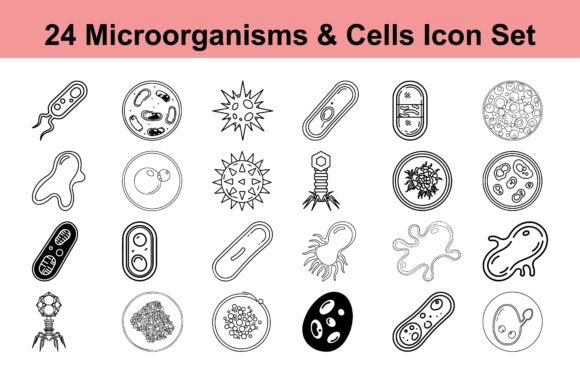
This icon set is a curated library of twenty-four distinct vector graphics, each representing a different microscopic organism, cell structure, or biological element. The collection covers bacteria, viruses, protozoa, fungi, and key cellular components such as nuclei, mitochondria, and DNA strands. Every icon follows a consistent outline style with smooth, uninterrupted lines and minimal detailing, ensuring readability at any size—from small interface buttons to large poster displays.
The set is delivered in high-quality, fully editable formats, allowing you to resize, recolor, and adapt each icon to match your project's visual identity. Whether you need to align them with a specific brand palette or integrate them into a dark-mode interface, the flexibility is built in from the start.
Who Benefits from This Icon Collection?
This resource is designed for a broad audience, but certain users will find it especially valuable:
- Educators and trainers who create presentation slides, worksheets, or study guides for biology, microbiology, or health science courses.
- Medical and laboratory professionals developing patient-facing materials, lab reports, or internal training documents that require clear, non-intimidating visuals.
- UI/UX designers working on health-tech platforms, telemedicine apps, or scientific software where icons must be recognizable at small sizes.
- Graphic designers and illustrators producing educational posters, scientific diagrams, or infographics for journals, textbooks, or marketing campaigns.
- Content creators and bloggers covering topics in biology, medicine, or public health who need royalty-free visuals that look professional and modern.
Exploring the Icons: What's Included in the Set
The 24 Microorganisms and Cells Icon Set is organized around five main categories of microscopic subjects. Each icon captures the distinctive morphology of its subject while staying true to the set's unified outline style.
Bacteria and Prokaryotes
Several icons depict common bacterial shapes—cocci (spherical), bacilli (rod-shaped), spirilla (spiral), and vibrio (curved rod). These are ideal for illustrating microbial diversity, infection mechanisms, or the role of bacteria in ecosystems. The outlines clearly show flagella, pili, and capsule layers where applicable, giving you scientifically grounded visuals without overwhelming complexity.
Viruses and Viral Particles
Viral icons include representations of adenovirus, bacteriophage, coronavirus, and influenza. Each highlights signature features such as spike proteins, capsid geometry, and envelope structures. These icons are especially useful for materials about infectious disease, vaccine development, or virology fundamentals.
Protozoa and Unicellular Eukaryotes
Paramecium, amoeba, euglena, and other protozoan forms are included with recognizable organelles—contractile vacuoles, nuclei, and cilia. These work well for lessons on cell motility, phagocytosis, or aquatic microbiology.
Fungi and Fungal Structures
Yeast cells, mold hyphae, and mushroom spore structures appear in simplified outline style. These icons support topics like fungal reproduction, decomposition, and medical mycology.
Cellular Components and Anatomy
Beyond whole organisms, the set includes icons for the nucleus, mitochondria, ribosomes, cell membrane, and DNA double helix. These general cell biology icons are versatile across many educational and professional contexts.
Key Features and Practical Strengths
Beyond the variety of subjects, several characteristics make this icon set stand out for real-world use:
- Scalable vector format: Icons maintain crisp edges whether used on a mobile screen or blown up to billboard size.
- Editable and customizable: You can change stroke weights, fill colors, and line styles to match your brand or presentation theme.
- Consistent proportions: All icons share similar visual weight and line thickness, which is crucial for creating cohesive dashboards or infographic panels.
- Minimal yet informative: The outline style avoids unnecessary shading or texture, making icons legible even in black-and-white print or low-resolution previews.
- Science-friendly design: Shapes and structures are simplified but not distorted—biological accuracy is maintained where it matters most.
Where to Use the 24 Microorganisms and Cells Icon Set
The versatility of this collection means it can be applied across a wide range of media and formats. Below are some common and creative use cases.
Educational Materials and Classroom Resources
Imagine a high school biology teacher preparing a unit on cell theory. With these icons, they can build a matching activity where students pair each icon with its correct name and function. The clean outlines make photocopies and digital handouts equally clear. Similarly, a university lecturer might embed the icons into slide decks to label diagrams of bacterial conjugation or viral replication cycles, replacing clunky clip art with professional, coordinated visuals.
Medical and Laboratory Communications
A clinical laboratory might use the icons in a patient education leaflet explaining different types of infections. The virus and bacteria icons can visually distinguish viral from bacterial illnesses, helping patients understand why antibiotics aren't always prescribed. On the professional side, lab reports or internal presentations benefit from icons that standardize how organisms are represented across departments.
Digital Products and Health-Tech Interfaces
For UI/UX designers, these icons are a practical asset. A telemedicine app could use the microbe icons in symptom checkers—showing a virus icon for flu-like symptoms or a bacteria icon for suspected strep throat. The consistent stroke style ensures all icons look like they belong to the same system, which is critical for polished interface design. Dashboard metrics tracking infection rates, lab results, or research progress also gain clarity from recognizable iconography.
Scientific Posters and Research Journals
Researchers preparing conference posters or journal graphics often need clean, reproducible figures. This icon set reduces the time spent drawing basic cell structures from scratch. A poster on antimicrobial resistance, for instance, could use the bacterial icons alongside the DNA helix icon to show genetic mutation pathways. The editable format means you can recolor icons to highlight different strains or experimental conditions.
Marketing and Public Health Campaigns
Nonprofits or government agencies running vaccination awareness campaigns can use the virus icons to visually communicate threats and solutions. The approachable outline style feels educational rather than alarming, which is a delicate balance in public health messaging. Infographics shared on social media retain legibility even at small sizes, thanks to the minimal line work.
Considerations and Limitations
No resource is perfect for every scenario. Being aware of the set's limitations helps you decide if it meets your specific needs.
- Outline style only: If your project requires photorealistic or highly detailed cellular imagery, these icons may feel too simplified. They are best suited for schematic, instructional, or interface contexts.
- Twenty-four icons may not cover every organism: While the selection is representative, it cannot include every microbe or cell type. You may need to supplement with additional custom icons for very specialized topics.
- No pre-colored variants: The set provides the outlines; you must apply your own fill colors or gradients. This is a strength for customization but requires design software skills.
- Learning curve for editing: Users new to vector editing software (like Adobe Illustrator or Figma) may need a short learning period to resize or recolor icons effectively.
How to Choose the Right Icon Set for Your Project
When evaluating whether the 24 Microorganisms and Cells Icon Set is the right fit, ask yourself these questions:
- What is the primary use context? For digital interfaces and presentations, the outline style is ideal. For printed textbooks, ensure your printer handles fine lines well.
- Do you need consistency across many visuals? If your project requires a uniform look among dozens of icons, the consistent proportions in this set will save you time.
- How much customization is required? If you need icons that match a specific color palette or brand style, the editable vector format is a major advantage.
- What level of detail does your audience expect? Lay readers and students benefit from simplified icons, while specialist researchers may prefer more anatomical precision.
Real-World Scenario: Building a Microbiology Module for an E-Learning App
Consider a product manager at a health education startup who needs to create an interactive module on common pathogens. Using the 24 Microorganisms and Cells Icon Set, they can quickly populate the interface with recognizable icons for each lesson topic. The virus icon appears when learners study influenza; the bacteria icon represents E. coli; the protozoan icon introduces malaria. Because all icons share a uniform style, the module feels cohesive and professionally designed. The product manager can also recolor the icons to indicate severity levels—red for high-risk pathogens, green for harmless microbes—without needing a designer to redraw anything. This flexibility speeds up development and keeps the user experience intuitive.
Final Thoughts on the 24 Microorganisms and Cells Icon Set
In a world where visual communication is central to education, medicine, and technology, having access to a well-designed, scientifically grounded icon set is a practical advantage. The 24 Microorganisms and Cells Icon Set succeeds in offering a versatile library that balances clarity, consistency, and customization. Whether you are a teacher preparing tomorrow's lesson, a designer refining a health app, or a researcher visualizing data for publication, these icons provide a solid foundation for your work.
The set's outline style and editable format mean it can adapt to nearly any project without losing its professional character. While it may not replace highly detailed anatomical illustrations for specialized research, it serves beautifully in the everyday contexts where clear, approachable visuals matter most.
Explore the microscopic world with confidence—one icon at a time.