Traditional Japanese Culture Essentials: The Art of Visual Storytelling in Heritage Design
Japan's cultural footprint extends far beyond its borders. From the quiet elegance of a tea ceremony to the bold symbolism of a torii gate, the visual language of Japanese tradition resonates with audiences worldwide. Yet for professionals who work across tourism, education, branding, and design, capturing that essence in a clear, respectful, and versatile way presents a recurring challenge. This is where the concept of Traditional Japanese Culture Essentials becomes more than a thematic collection — it becomes a strategic toolkit for authentic visual communication. In this article, we examine what this concept means, why it matters across multiple industries, and how a well-crafted icon set can support the growing demand for culturally rich, adaptable design assets.
What Traditional Japanese Culture Essentials Really Means
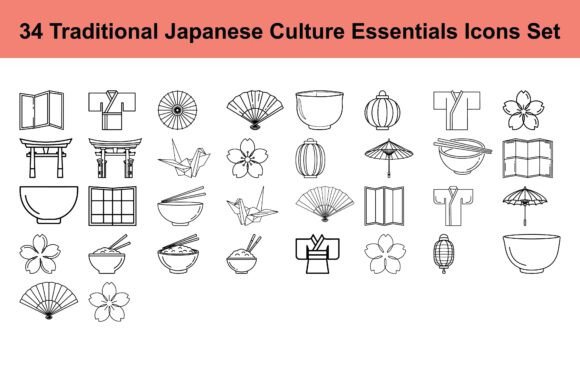
At its core, Traditional Japanese Culture Essentials refers to the curated set of visual symbols, motifs, and objects that collectively represent Japan's heritage in a recognizable, respectful, and educationally valuable way. These are not random decorations but carefully selected icons that carry centuries of meaning: the folded crane symbolizing peace and longevity, the daruma doll representing perseverance, the delicate cherry blossom reminding us of impermanence, and the elegant kimono reflecting artistry and tradition. When packaged as an icon set, Traditional Japanese Culture Essentials becomes a practical resource that distills complex cultural narratives into clean, scalable vector graphics. The result is a visual shorthand that communicates instantly, whether on a tourism website, a classroom infographic, or a promotional brochure for a cultural festival.
What makes this concept essential today is its dual function: it preserves the integrity of traditional symbols while adapting them for modern workflows. The outline-style vector format, for instance, allows designers to maintain a lightweight, consistent look across digital and print media. The inclusion of AI, EPS, and JPG files ensures that whether you are a freelance designer working in Adobe Illustrator or a marketing coordinator preparing a quick presentation, the assets remain accessible and editable. This flexibility does not dilute the cultural significance — rather, it amplifies reach by making heritage visuals easy to integrate into everyday projects.
The Growing Demand for Culturally Grounded Visual Assets
Across the creative and business landscape, there is a marked shift toward authenticity. Consumers, travelers, and learners are increasingly savvy about cultural representation. A generic "Asian-inspired" graphic no longer suffices; audiences expect specific, accurate, and respectful depictions. This is especially true in the tourism sector, where destinations are competing for attention in a saturated market. According to industry reports, visual content is the primary factor influencing travel decisions for a majority of potential visitors. When a tourism board or travel guide uses icons like those in the Traditional Japanese Culture Essentials set — a precise pagoda silhouette, a correctly proportioned shinto shrine, a recognizable bento box — it signals both competence and cultural awareness.
Educational publishers and content creators face similar expectations. A textbook or digital lesson on Japanese history or geography benefits immensely from imagery that is both accurate and aesthetically coherent. The icon set provides a reliable reference point: the same visual vocabulary appears across chapters, reinforcing learning while avoiding the distraction of inconsistent clip art. For educators, this consistency supports cognitive retention. For students, it builds a mental library of cultural symbols that goes beyond rote memorization.
Why Designers and Marketers Are Paying Attention
Several converging trends explain the rising interest in curated heritage icon sets like Traditional Japanese Culture Essentials. First, the global appetite for Japanese culture has never been broader. From anime and cuisine to martial arts and minimalist aesthetics, Japanese influences permeate Western and pan-Asian markets alike. This widespread fascination creates a natural demand for visual assets that can support content across travel, lifestyle, food, fashion, and entertainment verticals. An icon set that covers diverse elements — from a sake bottle and a lantern to a samurai helmet and a zen garden — allows a single designer to serve multiple projects without sourcing from ten different libraries.
Second, the vector icon market itself has matured. Professionals no longer settle for low-resolution, awkwardly styled symbols. They expect scalability, consistency, and a degree of polish that works at both small mobile screen sizes and large banner dimensions. The outline-style approach used in this collection aligns with the prevailing preference for clean, minimal, and highly legible iconography. It fits seamlessly into flat design systems, modern UI frameworks, and even print collateral like postcards and posters. Because the set is provided in AI, EPS, and JPG formats, it meets the technical requirements of both veteran designers and content teams working with limited software resources.
Third, the experiential economy places a premium on storytelling. Brands and organizations do not just sell a product or a destination; they sell an experience. An icon of a tea whisk or a folding fan carries with it a world of associations — tranquility, craftsmanship, ritual. When used in a brochure, website header, or social media graphic, that icon primes the viewer's emotional response before they read a single word. For marketers, this is an efficient way to build atmosphere and credibility without lengthy explanatory text. The Traditional Japanese Culture Essentials set effectively becomes a visual shorthand for the entire cultural experience, lowering the barrier to emotional engagement.
Changing Workflows and Evolving Expectations
The way creative professionals source and use icons has changed significantly. Ten years ago, an icon set might have been a static collection of raster images, each locked into a specific size and resolution. Today, the expectation is modular, responsive, and customizable. The Traditional Japanese Culture Essentials icon set responds to this shift by offering fully editable vector files. This means a marketer can change the stroke color to match a brand palette, scale the icon to fit a hero section, or combine multiple icons into a custom infographic without losing quality or cohesion.
Moreover, the collaborative nature of modern content production demands file formats that work across teams. A graphic designer may prefer the precision of AI, a web developer may integrate EPS into a prototyping tool, and a project manager may need JPG for quick mockups. Having all three formats in one purchase eliminates friction and speeds up production cycles. For freelancers juggling multiple clients, this efficiency translates directly into more competitive proposals and faster turnaround times. For in-house teams, it reduces dependency on a single software ecosystem, allowing flexibility in tool choice.
Another evolving expectation is the desire for ethical and culturally sensitive design. Using an icon set that has been intentionally curated — rather than scraped from generic sources — provides a layer of confidence. Creators can be assured that the depictions are not caricatures or stereotypes but respectful representations. This matters especially when projects will be viewed by audiences with direct cultural knowledge. A well-designed daruma icon, for example, includes the distinctive round shape and blank eye, inviting appropriate cultural context rather than misrepresentation. The set's focus on essentials rather than exhaustive breadth also encourages thoughtful selection, prompting users to research and explain the symbols they deploy — a practice that enriches the final work.
Practical Applications Across Contexts
The versatility of the Traditional Japanese Culture Essentials icon set becomes evident when we look at real-world use cases. A travel agency specializing in Japanese tours might use the icons to build a visual itinerary: a plane icon, a hotel icon, and then a series of cultural highlights like a temple, a hot spring, and a market stall. This approach transforms a plain text schedule into an engaging visual journey that reassures clients of the richness of the experience. Similarly, a cultural foundation planning a Japanese film festival could use the icons on posters, programs, and social media posts to signal the event's thematic focus without overwhelming the layout with photography.
Educational materials benefit from the set's clarity. A geography teacher preparing a unit on East Asia could incorporate icons into a map legend, making the lesson more interactive and visually appealing. A language instructor might use the icons as prompts for vocabulary exercises: students identify the object and then learn the Japanese term. For museums and galleries, the set offers a cost-effective way to produce signage, exhibition guides, and digital catalogs that maintain a consistent visual identity throughout a hall or gallery space.
Entrepreneurs in the lifestyle and product space can also leverage these visuals. A specialty tea company might use the matcha whisk and tea bowl icons on packaging inserts or website product descriptions. A clothing brand inspired by Japanese aesthetics could incorporate the kimono or geta icon into lookbooks or mood boards. The key advantage is that the icons are not tied to a single season or campaign; their relevance endures because the cultural elements they represent are timeless. Investing in a comprehensive set like this reduces the need for repeated icon purchases and ensures that a brand's visual language remains rooted in authentic references.
Connecting Heritage Design to Larger Developments
On a broader level, the emergence of curated cultural icon sets reflects a larger movement toward intentional design and cross-cultural literacy. As global communication becomes more visual, the responsibility of creators to represent traditions accurately grows. Traditional Japanese Culture Essentials sits at the intersection of heritage preservation and modern digital practice. It acknowledges that culture is not static — it adapts to new media, new formats, and new audiences — but that the core symbols must be handled with care.
This trend parallels developments in the tourism industry, where destinations increasingly emphasize authenticity over generalization. Travelers no longer want a generic "Asian experience"; they want to understand the specific rituals, crafts, and landmarks that define a place. Visual assets that support this nuanced storytelling are invaluable. Similarly, in education, there is a push toward culturally responsive materials that honor the diversity of global traditions. Using a carefully designed icon set is one small but meaningful way to participate in that shift.
The technology sector also plays a role. As design tools become more collaborative and cloud-based, file formats that are compatible across platforms become essential. The inclusion of AI, EPS, and JPG in this set acknowledges the reality of hybrid workflows — where a designer might work on a desktop while a content manager reviews on a tablet. This pragmatic approach to file delivery aligns with the broader move toward interoperability in creative software ecosystems.
A Practical Resource for a Connected World
Ultimately, Traditional Japanese Culture Essentials is more than a collection of icons. It is a response to a real and growing need: the demand for visual assets that are culturally informed, technically flexible, and aesthetically cohesive. For professionals across tourism, education, marketing, and design, it offers a shortcut to credibility and a foundation for creative expression. Whether you are building a campaign, a curriculum, or a brand identity, having a reliable set of heritage icons at your fingertips frees you to focus on the higher-level work — storytelling, connection, and cultural exchange.
In a crowded visual landscape, the difference between a generic graphic and a meaningful symbol is vast. The Traditional Japanese Culture Essentials icon set bridges that gap by delivering tools that respect the past while serving the present. For anyone committed to authentic, effective, and beautiful visual communication, it represents a valuable addition to the creative toolkit.
Explore the set, experiment with the formats, and let these carefully crafted icons bring depth and clarity to your next project. The heritage of Japan is rich — visual storytelling helps it travel.