The Visual Language of Food: How Red Line Art Food Icons Transform Branding and Design
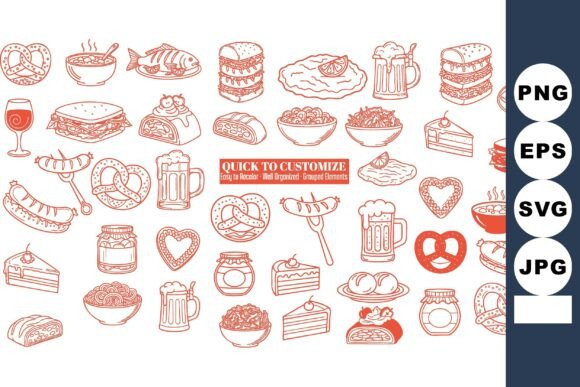
Food imagery in design has undergone a quiet revolution. Where once photorealistic photography or heavily shaded vector illustrations dominated menus and packaging, a lighter, more expressive approach has taken hold. Among the most distinctive trends is the rise of red line art food icons—a style that strips food down to its essential contours and delivers it with character, warmth, and immediate recognizability. This playful hand-drawn food icon collection, featuring pretzels, sausages, beer mugs, sandwiches, desserts, and fish in red line art style, represents more than a set of graphics. It signals a shift toward authenticity and approachability in visual communication.
For professionals working in restaurant branding, packaging design, or food-related infographics, understanding the value of this aesthetic is increasingly important. The red line art approach offers a unique balance between minimalism and personality, making it suitable for a wide range of applications while maintaining a cohesive visual identity. This article explores the characteristics, practical uses, technical considerations, and real-world relevance of this icon collection, with an emphasis on how it serves diverse audiences from creators to business owners.
The Rise of Hand-Drawn Line Art in Food Design
Line art has always held a place in illustration, but its recent resurgence in commercial design is tied to a broader cultural appetite for handmade, human-centered visuals. In an era of endless digital polish, audiences respond to imperfection. A slightly uneven line, a playful curve, or a deliberately simplified shape conveys something that hyper-realism cannot: the presence of a hand and a personality behind the work. The red line art food icons in this collection lean into that sensibility. The strokes feel deliberate yet loose, giving each food item—whether a soft pretzel or a stacked sandwich—a sense of movement and life.
Red, as a single color choice, carries its own weight. It is associated with appetite, energy, and warmth. In food contexts, red stimulates hunger and draws attention. Using red as the sole color in a line art collection creates visual unity while allowing the shapes themselves to do the storytelling. The result is a set of icons that feel both cohesive and lively, without the noise of multiple colors competing for attention.
The specific items included in the collection—pretzels, sausages, beer mugs, sandwiches, desserts, and fish—point to a curated range of food categories. This is not a generic fruit-and-vegetable set. It leans into comfort food, social dining, and indulgence. Pretzels and beer mugs suggest beer gardens and casual gatherings. Sandwiches and sausages evoke quick service and street food. Desserts and fish round out the collection with variety while keeping the tone cheerful and approachable. This editorial curatorial choice makes the icons immediately useful for certain business contexts, such as gastropub menus, food truck branding, or festival signage.
Why Red Line Art Works for Menus, Packaging, and Branding
The practical applications of this icon collection are broad, and each use case benefits from the style's inherent strengths. Let's walk through the primary contexts where red line art food icons deliver real value.
Menus and Restaurant Signage
Menu design is fundamentally about guiding the eye and communicating quickly. A diner should be able to glance at a menu and understand the category of food, the vibe of the establishment, and the visual identity of the brand within seconds. Photographs can be distracting, inconsistent in quality, and expensive to update. Red line art icons solve these problems. Their uniformity ensures that every section of the menu feels connected. A pretzel icon next to the appetizers and a beer mug icon next to the drinks section creates a rhythm that feels tactile and friendly. Because the icons are hand-drawn, they also convey a sense of craft—suggesting that the food itself is made with care. For restaurants, cafés, and food halls, this visual language helps build a brand identity that feels warm without being cluttered.
Packaging Design
Packaging is a crowded space. On a shelf full of bold typography and glossy photography, a clean red line art icon can be a breath of fresh air. The simplicity of the line art allows the product name and ingredients to remain legible while still providing a strong visual anchor. For small-batch food producers, artisanal snack brands, or specialty beverage companies, using a hand-drawn food icon collection on labels and boxes signals authenticity and approachability. A sausage icon on a package of artisan bratwursts, rendered in the same red line style as the brand's logo, builds consistency across product lines. The fact that the collection includes SVG and EPS files means the icons can be scaled without loss of quality, whether applied to a small jar label or a large shipping box.
Branding and Identity Systems
For designers building a brand identity for a food-related business, a cohesive icon set is a powerful asset. The red line art style lends itself to a monochromatic or limited-color brand palette, which is both cost-effective for printing and visually striking. The playful hand-drawn quality means the brand feels youthful, energetic, and approachable—qualities that are particularly valuable for businesses targeting families, younger demographics, or casual dining environments. The icons can be used as standalone elements, combined with typography, or repeated as patterns on napkins, coasters, or takeaway bags. The inclusion of multiple file formats in the downloadable ZIP—SVG, EPS, JPG, and PNG—ensures that the same icons can be used across web, print, and merchandise without rework.
Restaurant Infographics and Digital Menus
Infographics have become a staple of food marketing, from social media posts explaining a dish's ingredients to digital menu boards showing daily specials. Hand-drawn line art icons are especially effective in infographic contexts because they reduce visual noise. A red line art fish icon next to a sustainability statistic, or a pretzel icon beside a calorie count, makes the information feel lighter and more engaging. The cheerful tone of the illustrations prevents the infographic from becoming too clinical or data-heavy. Restaurants and food brands that use infographics on their websites or in-store displays can create a consistent look by basing all icons on the same red line art style. This unity reinforces brand recall every time a customer sees the imagery.
Technical Versatility: SVG, EPS, JPG, and PNG Explained
A major advantage of this collection is the range of file formats included. For professionals who work across different mediums, having multiple formats in a single download saves time and prevents compatibility headaches. Let's examine what each format offers and when to use it.
SVG (Scalable Vector Graphics) is the format of choice for web and digital design. Because SVGs are resolution-independent, they can be scaled to any size without pixelation. A red line art pretzel icon used as a tiny menu marker on a mobile site can be blown up to fit a hero banner without any loss of crispness. SVGs are also editable in vector software, allowing designers to tweak stroke weights or adjust colors if needed. For developers, SVGs integrate directly into HTML and CSS, making them ideal for responsive design.
EPS (Encapsulated PostScript) is the industry standard for print production. If you are sending files to a commercial printer for menus, packaging, or signage, EPS is the safe choice. It retains vector data and is widely supported by professional layout software like Adobe Illustrator and InDesign. The EPS files in this collection ensure that the icons can be placed into print layouts at any resolution with sharp, clean edges.
JPG and PNG files serve the raster world. JPGs are useful for general-purpose images where file size matters, while PNGs support transparency, making them ideal for placing icons over photographs or colored backgrounds. A restaurant using red line art food icons on a website hero section might want the PNG version to layer over a dark background, while a markdown catalog might use JPGs to keep load times fast. Having all four formats available means no user is left scrambling for a converter tool.
Who Benefits from This Icon Collection
The audience for red line art food icons is broader than one might assume. While professional designers are the most obvious users, the collection serves a variety of roles and skill levels.
Designers and Creative Professionals
Graphic designers, web designers, and illustrators will appreciate the clean vector files and the ability to customize the icons. The hand-drawn style can be layered into larger compositions, combined with typography, or used as jumping-off points for custom illustrations. For designers working on tight deadlines, having a ready-to-use set of food icons in a consistent style eliminates the need to draw from scratch or search through multiple libraries for matching aesthetics.
Restaurant and Food Business Owners
Small business owners who manage their own marketing often lack the budget for custom illustration. A downloadable collection of playful hand-drawn food icons gives them professional-grade assets without requiring a design agency. They can use the icons to update their menu, create social media posts, or design promotional flyers. The cheerful, approachable style helps convey the personality of their establishment, whether it is a cozy café or a lively beer hall.
Educators and Hobbyists
Cooking schools, nutrition educators, and food bloggers can integrate the icons into worksheets, recipe cards, or online courses. The visual clarity of line art makes it suitable for educational materials where students need to quickly identify food categories. Hobbyists working on personal projects—such as recipe scrapbooks, party decorations, or custom gift tags—also benefit from the ready-to-use files. The PNG and JPG formats are particularly useful for those who do not have vector editing software installed.
Marketing Teams and Content Creators
Social media managers and content creators need visuals that stop the scroll. A red line art sausage icon or dessert icon can be used as a recurring motif in a series of posts, creating a recognizable visual signature. The icons work well in flat design contexts, which dominate modern social media aesthetics. Because the collection includes multiple food types, a content creator can build an entire content calendar around the icons, pairing each one with a recipe, a fun fact, or a promotional offer.
Practical Considerations When Using Line Art Icons
While the benefits are significant, there are a few considerations to keep in mind when working with red line art food icons in a project. Understanding these nuances helps ensure the final result looks polished and intentional.
Color integration is one factor. The icons are designed in red line art, which means they work best against neutral or complementary backgrounds. White, cream, light gray, or dark backgrounds tend to make the red pop. If your brand palette includes strong competing colors, you may need to adjust the icon color or the background to maintain contrast and readability. Because the icons come in SVG and EPS formats, adjusting the color in vector software is straightforward.
Scale and context also matter. Hand-drawn line art that looks playful at a certain size can feel too thin or too chunky when scaled dramatically. It is a good practice to test the icons at the exact dimensions you plan to use them before finalizing a layout. The vector files make this testing easy since you can scale without quality loss.
Consistency across applications is another consideration. If you use the icons on your website, menu, packaging, and social media, ensure that the red line art remains consistent across all channels. Slight variations in stroke weight or color temperature can create a disjointed brand experience. The advantage of a single-source collection is that you are starting from a unified set—maintaining that unity is a matter of using the same source files everywhere.
Observing the Trend: Why This Style Resonates Now
Line art has appeared in design cycles for decades, but the current iteration feels distinct. The rise of digital minimalism, combined with a nostalgic turn toward analog aesthetics, has made hand-drawn elements more desirable. In a landscape saturated with AI-generated imagery and hyper-polished stock photos, a hand-drawn quality signals human input. The red line art food icons collection taps into this cultural moment by offering a style that feels both contemporary and timeless. The food items chosen—pretzels, sausages, beer mugs, sandwiches, desserts, and fish—are universal enough to cross cultural boundaries while specific enough to feel curated.
For business owners and creators, aligning with this trend is not about chasing the latest fashion. It is about recognizing that audiences respond to visuals that feel genuine. A red line art pretzel on a menu does more than indicate a menu section—it tells the customer that the brand has taken the time to present itself with care. That impression, subtle as it may be, influences perception and builds trust.
Workflow Integration: From Download to Deployment
Understanding how to integrate the collection into a typical workflow helps users get the most out of the download. The process is straightforward regardless of your role. After downloading the ZIP file, you will find separate folders or files for each format. If you are a designer working in vector software, the SVG or EPS files can be opened directly, edited, and exported as needed. If you are a business owner managing your own website, the PNG files can be uploaded immediately to your content management system. For print projects, sending the EPS files to your printer ensures the highest quality output.
The inclusion of multiple formats reduces friction. There is no need to convert files or worry about losing transparency. Each format has been prepared with the end use in mind. SVG files are optimized for web performance, EPS files are print-ready, JPGs are compressed for everyday use, and PNGs retain transparency for layering. This level of foresight means the collection is functional out of the box, saving time and eliminating guesswork.
Final Thoughts on a Playful Asset
A playful hand-drawn food icon collection in red line art style is more than a decorative asset. It is a strategic tool for anyone communicating about food visually. Whether applied to a menu, a package, a website, or a social media post, the icons carry a consistent message: this brand is approachable, thoughtful, and full of character. The combination of cheerful subject matter—pretzels, sausages, beer mugs, sandwiches, desserts, and fish—with the expressive quality of red line art creates a visual language that speaks to a wide audience without saying too much.
For professionals, the technical versatility of the SVG, EPS, JPG, and PNG formats ensures that the collection fits seamlessly into existing workflows. For hobbyists and small business owners, the ease of use and immediate applicability make it a practical resource. In a design landscape where authenticity is increasingly valued, hand-drawn line art offers a way to stand out while staying simple. The red line art food icons collection embodies that balance, making it a relevant and useful addition to any food-related design project.