Minimal Bear Paw and Bird Track Icons for Practical Design Work
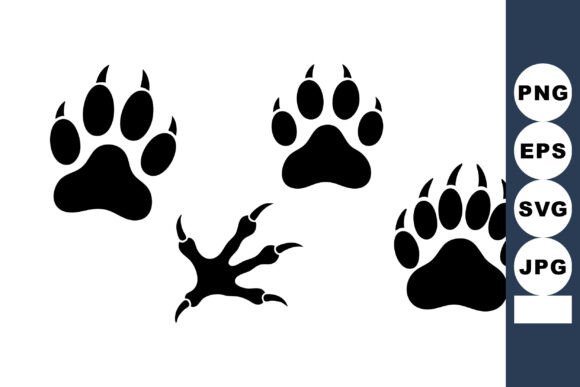
Small visual details often carry the weight of brand identity or educational clarity. A single paw print or bird track can communicate everything from wilderness and adventure to biology and tracking. The challenge lies in finding iconography that is both accurate enough to be credible and simplified enough to work across formats, sizes, and contexts. Minimal Bear Paw and Bird Track Icons addresses that need directly. It offers a clean, monochrome set of three stylized bear paw prints and one clawed bird footprint, rendered in a flat icon style that avoids unnecessary ornamentation. For anyone building wildlife logos, nature infographics, trail signage, or educational materials, this collection provides a practical foundation without introducing visual noise.
What the Icon Set Delivers and Why It Matters
At its core, this resource is a small but focused collection of vector and raster assets. The ZIP archive contains SVG, EPS, JPG, and PNG files, which means the icons can be dropped into nearly any workflow without conversion hassles. The bear paw prints vary in pose and orientation, giving designers three distinct options for composition, while the single bird track adds a complementary element that expands thematic possibilities. The monochrome treatment ensures the icons remain legible at small sizes and reproduce cleanly in print or on screen.
The decision to keep the illustrations minimal is not a limitation but a deliberate strength. Many wildlife icon sets lean toward excessive detail: fur texture, claw shading, or environmental backgrounds. Those extras can look impressive at full size but become muddled when scaled down or printed on low-resolution media. Minimal Bear Paw and Bird Track Icons avoids that trap. Each shape is reduced to its essential contour, which means the icons maintain clarity whether they appear on a business card, a website header, or a field guide pamphlet. The flat style also aligns well with modern interface design, where simplicity supports faster visual processing and cleaner layouts.
Key Characteristics and Practical Strengths
The set includes four icon variations, which may seem modest at first glance. However, in real-world use, a limited number of well-executed symbols often performs better than a large library of inconsistent or overly detailed assets. The three bear paw prints offer enough variety to prevent visual repetition without overwhelming a layout. The single bird footprint serves as a contrast element that can anchor a secondary focal point or balance a composition. Together, they form a cohesive visual language that works across single-icon applications and multi-icon arrangements.
The monochrome palette is another practical advantage. Black-and-white iconography eliminates color-matching issues and reduces file size, which benefits both print production and web performance. When used in logos or branding, monochrome icons scale across merchandise, signage, and digital platforms without requiring color adjustments. For infographics and educational diagrams, the absence of color keeps the focus on shape recognition, which is especially important when teaching identification skills to students or outdoor enthusiasts.
File format variety further enhances usability. SVG and EPS are vector formats that allow infinite scaling without quality loss, making them ideal for large-format printing or high-resolution displays. PNG files with transparent backgrounds are ready for immediate use in presentations, social media graphics, or web mockups. JPG versions work well for quick placement in documents or offline viewing. Having all four formats in a single download eliminates the need to convert files or hunt for the right extension, which saves time during tight project deadlines.
Real-World Use Cases and Performance Observations
In practice, this icon set performs reliably across several common scenarios. For a freelance designer building a logo for a wildlife tracking app, the bear paw icons provide a recognizable anchor that reads clearly at 32 pixels or 300 pixels. The vector files allow the shapes to be recolored, rotated, or combined with typography without losing edge quality. For an educator preparing a field guide for a nature center, the PNG files can be inserted directly into a handout or digital slide deck. The flat style fits alongside modern instructional design aesthetics, where learners benefit from unambiguous visuals that do not distract from the content.
Marketing and content creators also find value here. A blogger writing about hiking safety or bear awareness can use the bear paw icons as section dividers, bullet point markers, or header accents. The simple shapes integrate easily into WordPress themes, Canva designs, or newsletter templates. Because the icons lack complex shading or gradients, they do not conflict with existing brand styles or color schemes. They function as neutral visual elements that reinforce a nature theme without competing for attention.
One realistic limitation to consider is the narrow thematic scope. If a project requires a wide range of animal tracks or wildlife symbols, four icons will not cover that need. The set is not a comprehensive library but a targeted toolkit for bear and bird track representation. For designers working on multi-animal infographics or trail systems that include deer, raccoon, or coyote tracks, supplementary assets would be necessary. However, for projects centered on bears and birds, the set provides consistent, high-quality options that avoid the inconsistency often found when pulling icons from multiple free sources.
Quality, Consistency, and Long-Term Value
The icon quality reflects careful attention to proportion and silhouette accuracy. While the shapes are minimal, they retain the key identifying features of bear paws and bird tracks. The bear paw prints show the characteristic five toes and broad pad shape, while the bird track displays the clawed three-forward-one-back arrangement typical of many bird species. This balance of simplification and accuracy is important for educational credibility and brand authenticity. A logo or diagram that uses overly generic footprints risks confusing viewers or appearing amateurish. These icons strike a reasonable middle ground between abstraction and realism.
Consistency across the set is strong. Each icon shares the same line weight, corner rounding, and overall visual density. This uniformity becomes especially apparent when icons are placed side by side in a row or grid. The visual rhythm feels intentional rather than mismatched, which is a sign of careful design coordination. For designers who value cohesive asset libraries, this consistency reduces the need to manually adjust or reapply styling to make assets work together.
Long-term value depends on how often the icons fit into recurring projects. For a wildlife center that produces seasonal materials, a university biology department that creates lab handouts each semester, or a outdoor brand that refreshes its web presence regularly, these files remain usable year after year. The vector formats also allow future modification: resizing, recoloring, combining, or converting to new formats as software evolves. The download becomes a permanent asset rather than a one-use graphic.
Who Benefits Most and Under What Conditions
Small business owners launching a nature-themed brand will find the set immediately useful for logo exploration, social media graphics, and product labels. The flat monochrome style aligns with current minimalist branding trends, and the vector files allow professional output without requiring advanced illustration skills. Entrepreneurs who outsource design work can share the files with contractors as a starting point, saving time on initial asset creation.
Freelance designers and creative studios handling outdoor, adventure, or wildlife clients can use the icons as building blocks for larger projects. The SVG and EPS formats integrate smoothly with Adobe Illustrator, Affinity Designer, Inkscape, and other vector editing tools. For mockups and client presentations, the PNG files offer quick insertion into wireframes or pitch decks. The set also works well as a secondary element within larger compositions, such as background patterns, map legends, or signage systems.
Educators teaching environmental science, outdoor skills, or biology at the middle school through college level can incorporate the icons into worksheets, quizzes, slideshows, and identification cards. The simplicity of the shapes makes them suitable for photocopying or projection, where complex details would be lost. The bird track icon, while limited to one species type, serves as a useful example for discussing track morphology and classification.
Publishers producing field guides, nature magazines, or children's activity books will appreciate the clean file formats and consistent style. The icons can be reused across chapters, editions, or series without visual drift. The monochrome treatment also reduces printing costs when color is not essential, which matters for budget-conscious publications.
Content creators and bloggers covering topics like wildlife photography, hiking, camping, or animal behavior can embed the icons as visual accents that reinforce topic relevance without cluttering the page. The small file sizes of the PNG versions keep page load times low, which supports SEO performance and user experience.
Practical Recommendations and Workflow Fit
Before purchasing or downloading Minimal Bear Paw and Bird Track Icons, evaluate the specific needs of your current and near-future projects. If bear and bird tracks cover the majority of your icon requirements, this set offers a polished, ready-to-use solution. If your work demands broader taxonomic representation, consider combining this set with complementary icon packs that share a similar visual style. Mixing assets from different sources can work well when the line weights and design philosophy align, but it requires careful selection to avoid inconsistency.
When using the icons in logos, test how they appear at very small sizes, such as 16 to 24 pixels for favicons or app icons. The minimal style holds up well in most cases, but the claw details on the bird track may become less distinct below 20 pixels. Adjusting the stroke width or simplifying the shape further at small scales can help maintain legibility. For print applications, request a proof at final output size to confirm that the icons read clearly on paper or substrate.
For infographics and educational materials, pair the icons with clear labels and a consistent scale. The bear paw and bird track differ in overall size, so maintaining proportional consistency across the layout is important for accurate visual comparison. If the icons are used to represent specific species, consider adding a brief annotation or legend to explain which animal each track corresponds to, especially in contexts where multiple bear or bird species are discussed.
Finally, archive the downloaded files in a dedicated folder with clear naming conventions. The original ZIP structure preserves SVG, EPS, JPG, and PNG versions, but reorganizing by format or project can speed up retrieval. Because the icons are vector-based, they can be edited and repurposed indefinitely, making them a durable addition to any nature-focused design library.
Minimal Bear Paw and Bird Track Icons delivers exactly what it promises: clean, versatile, and functional wildlife icons that work across media without excess. For those who need simple bear paw and bird track representations with professional file support, this set is a practical investment that saves time and ensures visual consistency.